










 Architects
 Construction firms
 Dealers


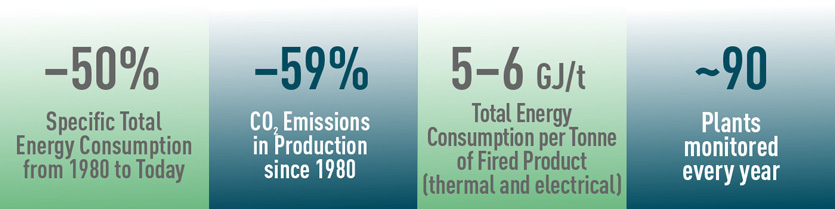
Over the past four decades, the Italian ceramic industry has reduced energy consumption by 50% and halved CO₂ emissions while maintaining product quality, transforming energy efficiency from a regulatory requirement into a competitive advantage and a defining feature of its industrial culture.
(June 2026) – The Italian ceramic tile industry, centred in the Emilia-Romagna region, has made efficiency a constant goal of its operations – from roller kilns equipped with heat recovery systems to cogeneration plants, photovoltaic arrays and intelligent process management. But efficiency does not end at the factory gate: it is an integral aspect of the product itself, enhancing the energy performance of buildings via ventilated façades, reflective surfaces and high-performance building envelopes.
Efficiency as a core principle: eliminating waste is a form of innovation
Energy efficiency in the ceramic industry did not originate from a decree or a European target. It is part and parcel of a manufacturing culture that considers waste a failure on every level – economic, environmental and human. Eliminating waste means utilising energy, raw materials, time and capital as effectively as possible, an approach that yields measurable results when adopted systematically across the entire production chain.
The Italian ceramic industry was one of the first sectors to understand that quality and efficiency are not incompatible goals, but instead go hand in hand. Improving a kiln’s energy performance not only reduces costs but frequently also improves the thermal stability of firing and therefore the quality of the finished product. In this respect, the maximum efficiency of industrial facilities is at once an environmental objective and a competitive asset.
There is one variable in this equation that is easily overlooked: the human element. Efficiency is not just a system; it is a mindset. An operator who switches off unused machinery, reports abnormal consumption or optimises a production sequence actively contributes to the overall result.
In this context, saving energy is not a sacrifice. It is a new way of looking at the process that generates value for companies, the local community and future generations.
Heat recovery from firing: the most energy-intensive stage of the production process
Firing is one of the most energy-intensive stages of the entire ceramic production process, with temperatures of between 1,000 and 1,250°C maintained for hours inside roller kilns measuring dozens of metres in length. It is therefore no surprise that this is where the majority of the efforts to improve energy efficiency have been concentrated. The firing of Italian ceramics is now a radically different process to that of the 1980s, with specific energy consumption falling from around 12 GJ/t to 5-6 GJ/t over the last decade alone.
This reduction in energy consumption is the result of a profound technological transformation. Cogeneration is one of the most effective tools, simultaneously generating electricity and thermal energy to boost overall plant efficiency. Meanwhile, kiln heat recovery systems are used to recapture energy that would otherwise be lost.
Alongside these technologies, solutions such as photovoltaics, digital monitoring systems and industrial automation have established themselves as industry standards. Today, many companies monitor energy consumption in real time and are able to intervene rapidly to optimise processes.
Modern kilns are more efficient, allow more precise temperature control and reduce energy waste. Taken together, these interventions have made a significant contribution to reducing the sector’s environmental footprint.
“When I think about energy, I think of photovoltaic arrays, cogeneration systems and kilns with heat recovery systems, but also of the continuous replacement of motors and lighting systems with higher-performance solutions.”
This kind of investment is essential for all production processes. Maintaining or improving product performance is a prerequisite for any industrial transformation, and reducing waste ultimately means improving all-round quality.
| Further reading |
| → The firing of Italian ceramic tiles |
| → The advantages of energy cogeneration |
Cogeneration and solar power: generating energy, not just saving it
Energy efficiency can be improved in two ways: reducing consumption and transforming how energy is generated. The Italian ceramic industry has invested significantly on both fronts: deploying cogeneration systems that produce electricity and thermal energy simultaneously from a single source, while installing solar arrays on the roofs of industrial buildings to generate clean solar energy.
The green energy generated by these photovoltaic panels covers an expanding share of the facilities’ electricity requirements, lowering grid dependency and further reducing the carbon footprint of production.
“We use systems such as photovoltaic panels and cogeneration to improve energy efficiency. Excellence is not just about the final product; it is also about how that product is made and the responsibility we bear towards future generations.”
Cogeneration is uniquely suited to the energy-intensive nature of the ceramic production process. The gas engines used to generate electricity inevitably produce waste heat that would be dissipated in a conventional setup. A properly sized cogeneration plant reclaims this heat, using it to power dryers, spray dryers or factory space heating. The benefits of cogeneration are therefore both environmental and economic in nature: less energy drawn from the grid, reduced emissions and lower, more stable operating costs.
Operators contribute by switching off idle equipment, managing processes carefully and avoiding the small daily inefficiencies which mount up over thousands of hours of operation. When combined with technological investments, these individual efforts create a powerful collective result.
| Further reading |
| → The advantages of energy cogeneration |
| → Clean energy generated by photovoltaic panels |
| → Photovoltaic tiles |
| → Photovoltaic Tiles |
Continuous investment: efficiency as a strategic business choice
Quality and efficiency contribute to the same goal of operational excellence. This is no mere marketing slogan but the culmination of decades of investment strategies that have established the Italian ceramic district as a global leader. Over the last twelve years, the sector has invested a total of €4.5 billion (6.7% of average annual turnover) in research, development and sustainable innovation. This level of investment is almost unmatched by any heavy industrial sector anywhere in the world.
“The company invests constantly to reduce consumption and waste. It is essential to design systems that aim not only to save resources but to ensure operational excellence from the outset. Using only the resources that are strictly necessary is a fundamental principle.”
This systematic approach is thoroughly documented and verified. Since 2010, Confindustria Ceramica and the Emilia-Romagna regional government have co-monitored the environmental performance of roughly 90 plants across the district each year through an Integrated Environmental Report. By tracking 35 separate indicators, from energy consumption to atmospheric and water emissions and waste management, the initiative has produced a comprehensive dataset unmatched anywhere else in the global ceramic industry.
| Further reading |
| → Italian ceramic tile industry: what path to decarbonisation? |
| → The energy efficiency of industrial facilities |
Using ceramic products to improve the energy efficiency of buildings
Energy efficiency within the ceramic industry does not stop at the factory gate. Whether a tile, clay brick or cladding element, the ceramic product itself improves the energy efficiency of the building in which it is installed. This dual nature – as a material produced with ever greater efficiency that in turn is capable of improving the efficiency of a building – is one of the most compelling arguments for using Italian ceramic products in contemporary sustainable architecture.
Ceramic ventilated façades are perhaps the most striking example: the air cavity between the external ceramic cladding and the structural wall creates a chimney effect that significantly reduces solar heat gain in summer, lowering indoor temperatures without relying on mechanical cooling. In winter, the same system helps mitigate heat loss. The result is a significant reduction in the energy required for both heating and cooling.
Scientific research has shown that high-reflectance ceramic surfaces can lower roof surface temperature by more than 10°C compared to conventional coverings, reducing summer cooling loads by up to 43% in hot climates. These figures align directly with the EPBD4 Directive (EU Directive 2024/1275), which identifies thermal inertia and passive cooling as high-priority strategies. Achieving Class A energy-efficient buildings that perform well even in summer is now a regulatory requirement, and ceramics offer concrete solutions.
Another prime example is the European LIFE SUPERHERO project, involving ten partners from Italy, France and Spain, including Confindustria Ceramica and the Centro Ceramico of Bologna. The project promotes ventilated and breathable clay roofing systems based on HEROTILES, an innovative solution developed during the predecessor project called LIFE HEROTILE. The solution exploits natural ventilation beneath the roof covering to dissipate solar heat without consuming any additional energy. Indeed, tests have shown that energy consumption for cooling is reduced by up to 50% compared to conventional pitched roofs. In addition to the benefits for individual buildings, the system helps to mitigate the urban heat island effect by lowering the temperature of the roof and the surrounding air, a significant benefit in densely built urban environments.
Another factor is the structural lifecycle. Unlike many alternative materials, ceramics rarely, if ever, require replacement. A properly installed tile lasts 50-100 years, meaning that the environmental impact of production is spread out over a very long period of time. Energy refurbishment of building envelopes using Italian ceramics is therefore a long-term investment, not just an aesthetic choice.
The latest frontier consists of photovoltaic tiles that integrate solar cells directly into the ceramic surface, transforming a building’s exterior cladding into an active energy-generating system. This innovation brings the process full circle, enabling ceramic products manufactured with clean energy to themselves generate clean energy.
| Data: 2024 Integrated Environmental Report · International Journal of Applied Ceramic Technology, 2025 |
Cover photo: Ventilated external façade in laminated stoneware by Cotto d’Este, “G. Pasquinucci” Heart Hospital – Massa Carrara, Italy (ph. Autori associati)