










Culture


A Question of Alchemy
(April 2026) – For those of us in the industry, it is no secret that technical and scientific knowledge – specifically chemistry, geology and even physics – are fundamental to ceramic production. But seeing this concept so eloquently presented in a museum primarily dedicated to ceramics as an art form – an expression of the human soul and intellect – was a welcome surprise.
We should, perhaps, have expected this from the title. ‘Alchemy’ was not chosen by chance; while it clearly references science, it also serves as a somewhat ‘vintage’ term. Alchemical thought is widely regarded as the precursor to modern chemistry, prior to the birth of the scientific method.
The exhibition “Alchimia Ginori 1737-1896. Arte e tecnica in manifattura” is currently showing at the MIC in Faenza and will run until 2 June 2026.
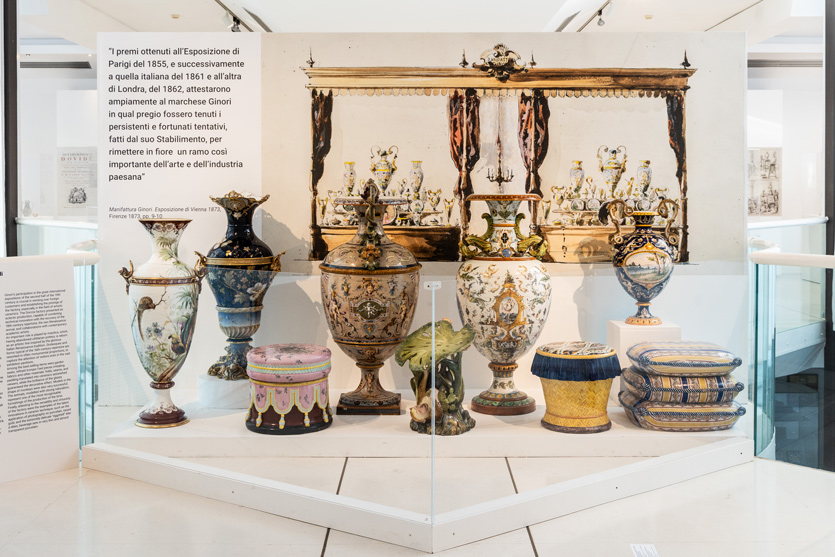
The exhibition demonstrates that Ginori’s historical importance stems not just from aesthetic and artistic quality, but also from continuous technological evolution, the scientific study of glazes, colours and the techniques illustrated.
The exhibition is therefore a tribute not only to the artistic quality of ceramics, but also to their intrinsic technical aspects. This mirrors the ongoing evolution in the industrial ceramic and slab sectors, where manufacturers continue to push the boundaries of the material to produce ever-higher quality objects.
Revisiting two centuries of history at the Doccia manufactory – Ginori’s original production site – the exhibition offers a fresh perspective on the evolution of ceramics in the 18th and 19th centuries.
Through a wide selection of works and artefacts from the collections housed in the Ginori Museum and MIC Faenza, curators Oliva Rucellai and Rita Balleri explore the dialectic between creativity and material constraints, aesthetic research and scientific progress, and tradition and the changing tastes of patrons.
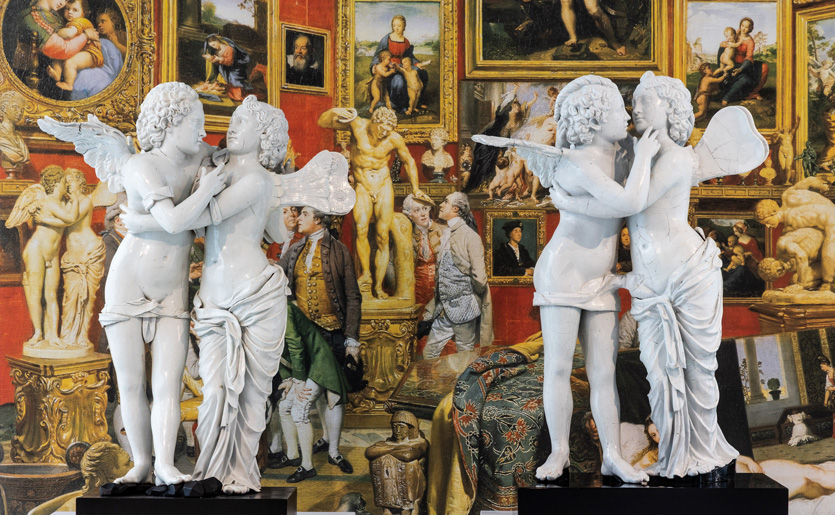
Left: Gaspero Bruschi e Manifattura Ginori, Amore e Psiche, porcellana dal marmo antico nella Tribuna della Galleria degli Uffizi, 1748 circa, Sesto Fiorentino, Museo Ginori. Right: Manifattura Ginori, Amore e Psiche, porcellana dal marmo antico nella Tribuna della Galleria degli Uffizi, 1750 ca., MIC Faenza.
“Behind a specific body, background colour or form that we now take for granted, there are often discoveries, inventions and failures of which we are unaware,” says Oliva Rucellai, chief curator of the Ginori Museum. “This exhibition invites us to explore Ginori’s history through these achievements.”
The story began in the first half of the 18th century, when Carlo Ginori, a chemistry enthusiast, founded the manufactory and personally sought the perfect recipe for the porcelain body.
The exhibition explores sections on porcelain sculptures, the expansion of pictorial decoration and the colour palette, and the innovations of Carlo Leopoldo Ginori (inventor of the four-storey kiln), the chemist Giusto Giusti, who rediscovered the lustre recipe of Renaissance majolica, and the factory’s first artistic directors.
The exhibition concludes with Ginori’s transition into a fully fledged modern industry and a look towards the 20th century, when the newly founded Richard-Ginori would achieve much of its prosperity through the production of electrotechnical porcelain – items not typically seen in museums.
With this exhibition, the MIC Faenza again pays tribute to the quality and depth of the Ginori Museum’s collections (currently closed to the public for renovation work at its home in Sesto Fiorentino), continuing a collaboration that began with the exhibition “Gio Ponti – Ceramiche”, held in Faenza from 17 March to 13 October 2024.
“This exhibition forms part of our museum’s programme to promote the Italian manufacturers that have shaped the history of Italian ceramics,” continues Claudia Casali, director of MIC Faenza. “Ginori is synonymous with elegance, but also with research, technique and technology. This exhibition is an extraordinary opportunity to see exceptionally important elements of Ginori’s production, such as the sculptural groups of Cupid and Psyche, brought together in one place – a unique event that is unlikely to be repeated.”
Weekly guided tour (included in the ticket price): every Saturday at 4.00 pm.