


Winners of the 13th edition of the Casalgrande Padana Grand Prix announced


December 2025 |
The auditorium at the headquarters of Casalgrande Padana hosted the award ceremony of the 13th edition of the Grand Prix, the international architecture competition that since 1990 has been promoting design culture through the innovative use of porcelain stoneware. Once again, this year, the event confirmed the role of the Grand Prix as a permanent observatory on contemporary architecture, bringing together more than 100 projects from all over the world.
Established with the aim of promoting the expressive and technological potential of Casalgrande Padana materials, the Grand Prix has over the years become a critical tool to interpret the evolution of architecture, interior design and construction languages. In over three decades since its inception, the competition has highlighted works where ceramic materials play a key role in the design, ranging from large urban surfaces to office buildings and residential projects
In the words of Casalgrande Padana President Franco Manfredini, “this has been possible thanks to the collaboration and the enthusiasm of the architects who send us details of their projects, year after year”. It is those professionals that transmit the energy and inspiration that help us to keep on growing, and who guide our efforts in terms of product and service innovation”.
The selection of the projects was entrusted to an international jury composed of architects, critics, university lecturers and specialised journalists, and was chaired by the company’s President, Franco Manfredini. Manfredini was assisted by a varied, authoritative panel: Simon Keane-Cowell, Editor-in-Chief of Architonic; Tarik Abd El Gaber, Architect and Deputy Editor of d’architectures magazine; Alessandra Ferrari, Architect of the National Council of Architects in Rome; Sebastian Redecke, Architect and Editor of Bauwelt magazine; Alessandro Valenti, Architect and Editor of ABOUT and elledecor.it (Hearst); Matteo Vercelloni, Architect and Editorial Consultant of INTERNI Magazine.
Called upon to assess the works submitted in complete autonomy, the jury engaged in a rigorous, elaborate discussion on the state of the art of contemporary design.
During the ceremony, the winning projects were announced in the three competition categories:
• Large Surfaces and Façade Cladding
• Shopping and Office Centres, Public and Service Buildings
• Residential Buildings
The evening saw the participation of numerous architects, designers and of course the award winners, fostering a climate of active, shared participation. The event came to a close with a concert by Maestro Andrea Griminelli, enhancing the award ceremony with an intense performance that turned the evening into a symphony of engagement and reflection.
This 13th edition of the Grand Prix was a celebration of the value of ceramics and craftsmanship: an occasion that underscored the role of the contest as an opportunity for dialogue between architecture, innovation and design culture. These awards continue to interpret the present, with each edition shaping new prospects for the international architecture scene.
The winners, divided by category, are listed below. The official announcement of the winners was followed by a reading of the motivations that guided the selection of the winning projects, highlighting the quality of the architectural solutions adopted, how the concept was accurately reflected in the construction, and the conscious use of the ceramic material.
Each project selected reflects a different interpretation of the potential of porcelain stoneware in contemporary architectural research.
LARGE SURFACES AND FAÇADE CLADDING
1st Prize
Andrea Grimaldi, Filippo Lambertucci, Dipartimento Architettura e Progetto Università La Sapienza – Allestimento interni della Stazione Metro Colosseo – Fori Imperiali, Linea C (Roma)
The dark grey cladding material used for both flooring and vertical surfaces draws attention to the dimensions of the spaces, and together with the incisions in the architectural layouts obtained by sanding, gives a museum-like appearance to the through areas and the surface connections, creating an immersive space projected towards the monument above.
2nd Prize
Alfonso Femia Atelier(s), Alfonso Femia /AF517 – Riqualificazione residenze sito EAI ex scuola fanteria, Montpellier (Francia); Cyber Place – Hub dell’innovazione, Cesson-Sévigné Rennes, (Francia); Residenze e alloggi per studenti, Asnières sur Seine, France; Quartiere residenziale Milano 3.0 (Milano)
Ceramic tiles play a key role in the project, helping to define architectures attentive to the role assigned to them in the urban environment. When carefully incorporated into historical buildings such as the former infantry school in Montpellier, the material is able to measure up to the surroundings, while in new builds, the use of three-dimensional ceramic tiles creates an interplay of reflections and colours that changes with the daylight and the seasons.
3rd Prize
Daniele Rangone, Studio Settanta7 – Plesso Scolastico di Busca (Cuneo)
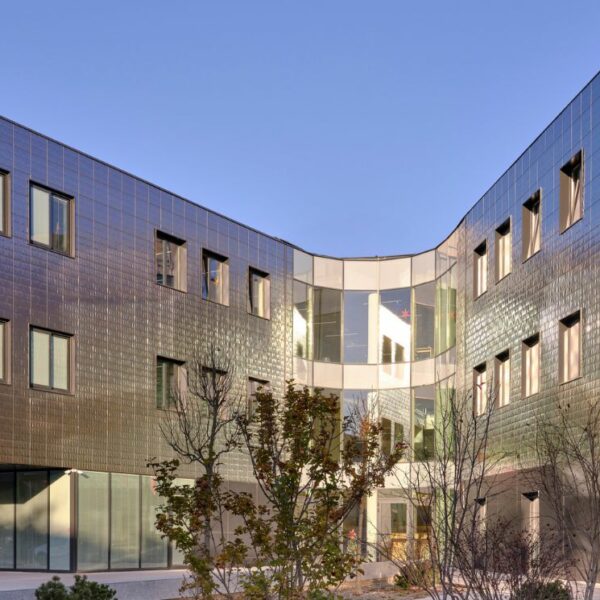
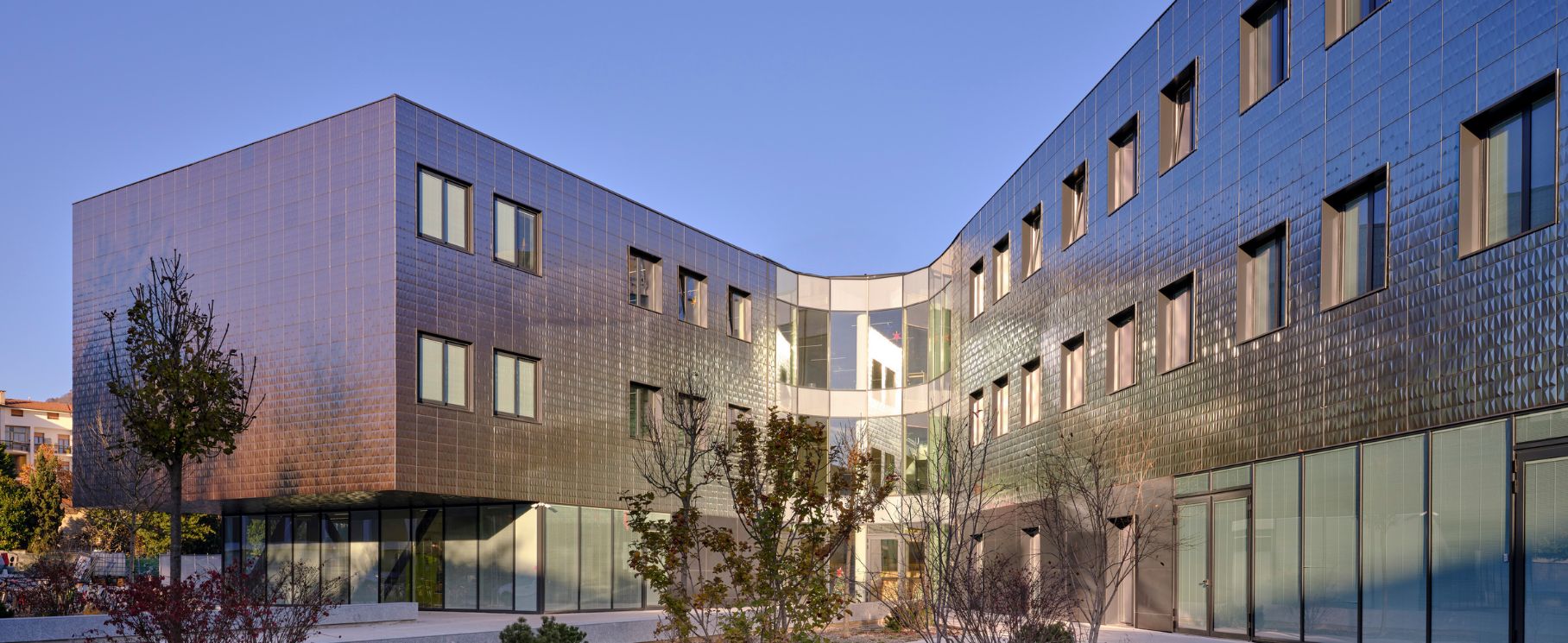
The cladding of the school building using three-dimensional porcelain stoneware in the colours silver and blue shapes a monolithic block suspended on top of a glass-clad base. The building thus obtained has an enveloping shape, with regularly placed openings alternating with effective recesses that combine with significant overhangs on the front parts, where the ceramic cladding plays a key role, continuing on the ceiling of the covered area and highlighting the material value of the iridescent volume.
SPECIAL MENTIONS
(large surfaces and façade cladding)
1 Cossu Toni Architetti, Andrea Cavicchioli – Nuovo centro parrocchiale Regina Pacis (Velletri)
The porcelain stoneware cladding on the façade continues, characterising the ascending elliptical volume corresponding to the liturgical space in the room below. The regular pattern of the vertical strips adds an expressive crowning top, which as well as increasing the width of the tiles used (which have the same length as those below), also adds a regular, three-dimensional geometric pattern that enriches the overall appearance of the construction.
2 Raffaele Truosolo, Giustino Marino, Cecere Management Edificio residenziale Nunziare II, (Aversa, Caserta)
The different light and dark shades of the porcelain stoneware tiles used for the façade cladding highlight the movements, overhangs and recesses that form the overall geometry of the construction, drawing attention to the key role ceramic materials play in the building.
3 Lemay / Bisson, Fortin / Perkins&Will – REM Stations (Montreal, Canada)
The use of tiles in shades of beige and grey in the through areas and waiting areas in the REM underground stations respond to a need for resistant, durable materials able to stand up to heavy footfall, and also help define the surface and underground areas, highlighting the clear, regular nature of the routes through the stations.
4 Gestione Governativa, Ferrovia Circumetnea, Antonio Trapani, Loredana Cucinotta, Daniele Zito – Stazioni Fontana e Monte Po della Metropolitana (Catania)
The tiles were chosen for their functional characteristics and durability essential for through areas, while the laying pattern of the various shades of tiles used creates an abstract pattern that also indicates the routes to follow, adding overall aesthetic value to the visual information aspect.
SHOPPING AND OFFICE CENTRES, PUBLIC AND SERVICE BUILDINGS
1st Prize
Facchinelli-Daboit-Saviane – Nuova Scuola Secondaria di 1°grado, Puos (Alpago, Belluno)
The regular, monolithic figure of the horizontal building, blending into the surrounding landscape with the mountains behind it and characterised by the compact brick colour of the external building envelope, strikes an effective, pleasing contrast with the terrazzo seminato flooring inside. Set into the light background of the porcelain stoneware tiles are chips in various grey tones and earthy shades, creating an effective irregular pattern that complements the rigour of the overall architecture.
2nd Prize
Arcos B – Piscina Tournesol Aldebert Bellier, Taverny (Francia)
The project for the renovation and extension of the Aldebert Bellier swimming pool was inspired by the historic Tournesol prefabricated collective swimming pool designed by the architect Bernard Schoeller and widespread throughout France at the end of the 1960s thanks to General De Gaulle’s “1000 Piscines” plan. The pattern and the mosaic shape of the small tiles used for the renovation of the areas surrounding the swimming pool complement the style of the original retractable metal roof, making the Tournesol model an interesting hybrid of architecture and macrodesign.
3rd Prize
SAUNA 360 – Ironmonger Row Bath SPA, Londra (UK)
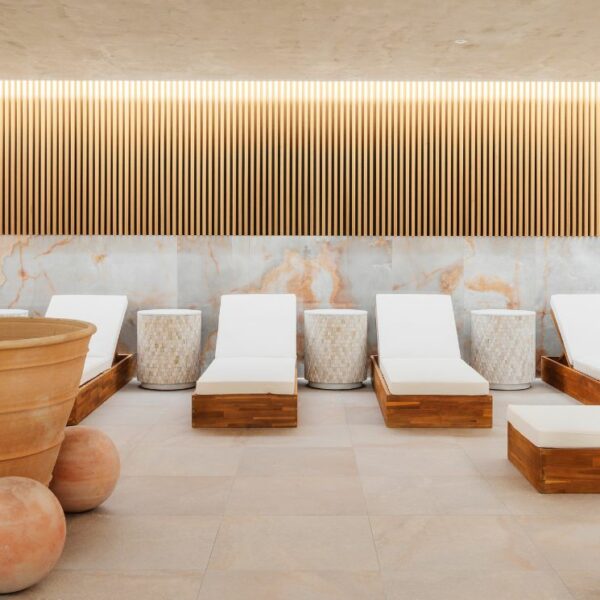
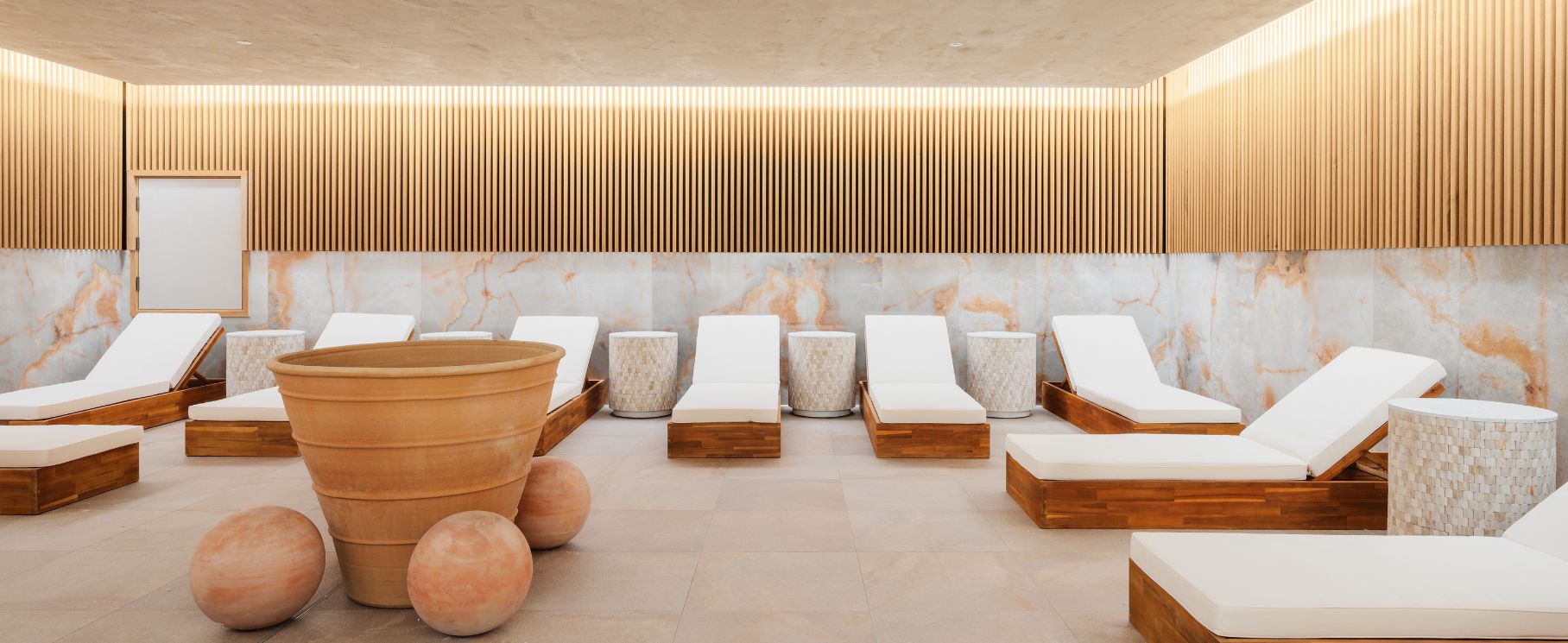
The radical renovation of the long-established spa in central London involved redesigning spaces and atmospheres using the most expressive, stylish materials in the Casalgrande Padana collections, with the aim of highlighting the various spaces and services. The undisputed key element in the project is porcelain stoneware, the style hallmark of the whole spa, with carefully studied combinations of colours and finishes.
SPECIAL MENTIONS
(shopping and office centres, public and service buildings)
1 SMT Studio, Giacomo Gajano Saffi, Mauro Castreghini – Nuovo Refettorio e cucina industriale del Pontificio Istituto Orientale (Roma)
In the overall design and the reference geometries of the Refectory, the use of porcelain stoneware tiles in different shades of beige, with a central strip formed by wood-effect plank tiles and a regular pattern of tiles shapes the overall look of the room, making the flooring one of the signature elements of the project.
2 FTA Filippo Taidelli architetto – Roberto Rocca Innovation Building / Humanitas Campus, Pieve Emanuele (Milano)
A significant construction exemplifying the presence of research and teaching facilities within modern hospital complexes, the composition of the Roberto Rocca Innovation Building features overlapping glass layers and is characterised by the clear-headed design of the layout and the simple palette of materials used. Along with the glass elements of the façade, the open concrete of the floor slabs and the wood of the load-bearing structures, the porcelain stoneware tiles used for the indoor and outdoor flooring and for some of the walls play a key role in the general composition of the building.
3. Fabio Mariani, Mariani Architetti – Hotel Fedora, Campitello di Fassa (Trento)
As part of the comprehensive renovation of an existing hotel, the decision to choose a single grey veined porcelain stoneware material for the whole of the ground floor and outdoor spaces, using it for both the indoor and outdoor flooring, for some parts of the walls and for various counter surfaces, created a seamless look throughout the various areas in terms of colour and material, making the tiles used the signature feature of the work carried out.
RESIDENTIAL BUILDINGS
1st Prize
Jacopo Mascheroni, JM Architecture – Villa Dellago, Torri del Benaco (Verona)
The ceramic cladding underscores the linear composition of the spaces, highlighting their regular nature and how they engage with the lake. The porcelain stoneware tiles characterize the horizontal surfaces as a whole, from the flooring to the roof, also covered with modular tiles in pale grey. From the interiors, the beige tiles extend out towards the outdoor spaces, highlighting the seamless transition, as far as the swimming pool, tiled with an intense grey-blue color.
2nd Prize
Anna and Krzysztof Paszkowscy-Thurow, Anna Thurow Architecture and Interiors – House
RS, Siadło Dolne, Polonia; House KD, Szczecin, Polonia
In these two household interiors, the use of porcelain stoneware tiles complements the sophisticated, linear overall design and the control of the figures that characterise the settings. The Casalgrande Padana materials used in the two projects form an indivisible part of the overall colour and material composition, thus playing an important role in the spaces.
3rd Prize
Martha Mezzèdimi, MEZZ Design Bureau – Piscina del Podere Necione, Asciano (Siena)
Carefully set into the hills of Siena, the swimming pool follows the contours of the land, forming a grey-blue porcelain stoneware line that slots seamlessly into the estate it is part of. The infinity pool solution enhances the view of the landscape in front, incorporated as a key element into the design concept.
SPECIAL MENTIONS
(residential buildings)
1 Agnieszka Burzykowska-Walkosz, Studio Formy – House in the mountains, Kościelisku (Polonia)
In this home interior, the natural wood of the ceiling and the door and window frames engages smoothly with the expressive, contemporary touch afforded by the porcelain stoneware used for entire walls and doors, as well as floor surfaces and bathrooms, in which the materials chosen were also used for the specially designed washbasins, forming part of a carefully measured overall composition.