











Interviews


Permeable organisms
(February 2025) | MAB Arquitectura’s design philosophy is rooted in a multidisciplinary approach that operates across all scales, seamlessly integrating urban planning, architecture and landscape. Their work is guided by a deep awareness of the environmental and socio-economic impacts of design, ensuring that each project makes a meaningful contribution to its surroundings.
Every project is conceived as part of a holistic vision, where different priorities and disciplines converge into a unified creative process. The firm’s research into living spaces addresses a broad spectrum of urban, environmental, energy and typological considerations.
While spanning multiple scales, from master plans and public space projects to the redevelopment of historical sites, brownfield regeneration and the design of residential, office and educational buildings, the defining characteristic of all these projects is perhaps that of “permeability”. “The concept of permeability takes on different meanings in our projects. It manifests as urban permeability – connections, flow continuity and spatial porosity; as architectural permeability – blurring the boundaries between interior and exterior, private and public; and as façade permeability – the interplay of light and shadow, transparency and depth of planes.”
Your firm is based in Milan and Barcelona. What is your background and how did your collaboration begin?
Our firm was founded in Barcelona in 2005 and has had an office in Milan since 2014. Our roots are deeply embedded in Mediterranean culture in terms of both origin and training, while our professional journey has taken shape in an international context, particularly in Spain and France.
Barcelona has been more than just a city for us. For thirteen years, it served as a model of urban development, an open-air laboratory where we had the opportunity to experiment and carry out ambitious projects. Here, we had the good fortune to collaborate with masters such as Martorell-Bohigas-Mackay (MBM), Carlos Ferrater (OAB) and Jordi Badia (BAAS).
After thirteen years, our journey led us to Milan, a city that inspired us to put everything we had learned into practice.
Our collaboration began spontaneously. Our first competition, “Abitare a Milano” (Via Gallarate), not only earned us significant recognition but also marked the foundation of our studio.
From residential to urban spaces, what is your design philosophy?
Our design philosophy focuses on the relationship between architecture and nature, the central role of public space and a commitment to sustainability, with a strong emphasis on the social and economic impacts of our interventions. We strive to create welcoming and inclusive places that enhance people’s lives and contribute to shaping the identity of tomorrow’s cities.
Each project is envisioned as a dynamic and interconnected system, where functional, aesthetic and environmental aspects work in synergy to create inclusive and sustainable spaces.
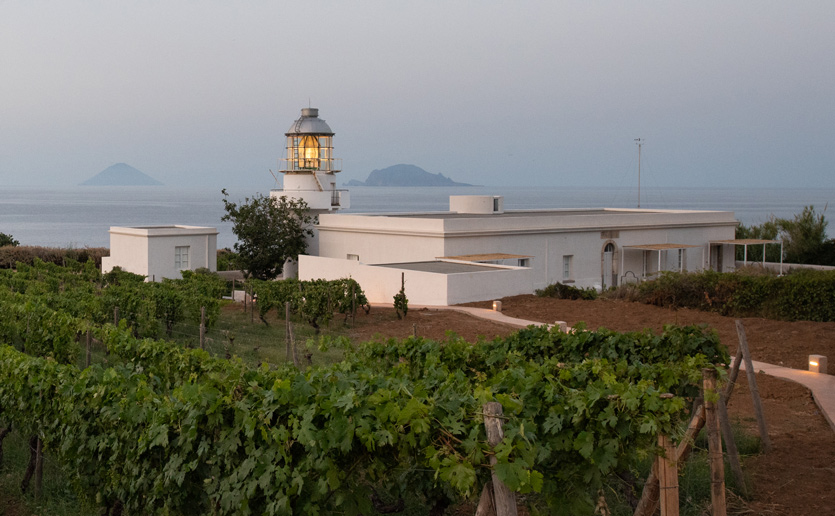 Capofaro Locanda & Malvasia Resort, island of Salina, ME (ph. Alberto Moncada)
What does “eco-neighbourhood design” entail?
Eco-neighbourhood design is a multidisciplinary approach that combines environmental, social and economic strategies to create sustainable living spaces. It incorporates innovative systems for renewable energy production, rainwater harvesting, waste reduction and passive energy-saving solutions to minimise environmental impact.
Along with technical sustainability measures, eco-neighbourhoods prioritise community well-being by providing shared spaces and integrated services that foster social cohesion. Some of our projects that embrace this philosophy include Via Moneta, Redo Merezzate, Milano4You and UpTown.
What do your current projects in Milan (the UpTown R8 residential buildings, the urban planning for the former Rogoredo Scalo and the Milano4You Smart District in Segrate) have in common, and what makes each unique?
These projects all share a strong focus on the relationship between architecture and nature, each engaging with large green spaces or parks to strengthen the connection between the built environment and its natural surroundings.
Another key feature is the courtyard system, in which residential buildings are arranged around semi-public green spaces. These are not just transitional zones but vibrant, lived-in areas offering amenities such as wellness facilities, coworking areas, multifunctional rooms and neighbourhood retail spaces. The outdoor spaces complement this vision with fitness areas, playgrounds and rest areas, extending the concept of contemporary living beyond the apartment walls.
The integration of private spaces, shared services and public areas lies at the heart of our design philosophy, responding to the evolving needs of modern society.
The design of the new Reggiolo Parish Centre won the In/Arch 2023 award. How does the project relate to its context?
The new parish centre and rectory in Reggiolo (RE) were conceived as a response to the damage left by the 2012 earthquake.
Despite its modest scale (1,000 square metres), the project is an authentic urban intervention, engaging deeply with the historical context. The spaces are organised around a sequence of courtyards, reinforcing the connection between the street and the grounds. This layout enhances the symbolic presence of the Church of San Rocco and the prayer hall, creating places with a strong identity and recognisability.
The project’s strength lies in its ability to integrate the new with the existing fabric while respecting its scale and historical values. It stands as a model of urban regeneration, shaping shared spaces where the community can rediscover a sense of belonging and togetherness.


Let’s talk about materials and design. Have you used ceramics in your projects? What do you see as its potential?
Ceramics is a material we particularly appreciate for its versatility, strength and durability. We have used it in our projects both for exterior façades and for interior floors and walls. One of its greatest strengths is its ability to adapt to different design needs and contexts. From porcelain stoneware, with its varied sizes and surface effects, to small-format glazed ceramics, mosaics and three-dimensional surfaces, the possibilities are almost unlimited.
Our ongoing research into materials, colours and textures evolves constantly in step with the innovations introduced by companies in the sector. We see ceramics as a material that enhances architecture, giving it identity and character. A prime example is the architectural restoration of Villa Liberty in Mondello.
In this project, we felt it was essential to connect the historical heritage with contemporary needs and functions.
 Villa Liberty, Mondello, PA (ph. Benedetto Tarantino)
BIOGRAPHY
01-02.2025
BIOGRAPHY

MAB Arquitectura was founded in Barcelona in 2005 by architects Floriana Marotta and Massimo Basile, with a second office established in Milan in 2014. Drawing on their professional experience in Paris and Barcelona, the two partners have developed a multidisciplinary approach that integrates urban planning, architecture and landscape design. A recipient of numerous awards, including two national IN/ARCH prizes, MAB Arquitectura works across multiple scales, from urban masterplans and landscape projects to large architectural interventions, restoration and interior design.
Some of the firm’s most notable projects in Milan include the residential and co-living complex in Via Moneta, the Redo-Merezzate residential district in Rogoredo Santa Giulia, the Social Housing project and public park in Via Gallarate, and the Piranesi 44 and Leone XIII residential complexes. In Paris, key projects include the Patronage Laïque-Centre Culturel and various social housing developments. The firm has also completed significant urban renewal and restoration projects, such as the Reggiolo Parish Centre, the conversion of the Capofaro Lighthouse on the island of Salina into a five-star Relais & Châteaux hotel, the restoration of an Art Nouveau villa in Mondello and the refurbishment of the historic Palmento di Tascante winery on Mount Etna.
