










Culture


A lesson in humanity
(October 2026) – This year’s Keynote Lecture at Cersaie concluded with a long round of applause from a visibly emotional audience. After describing the participatory process behind the project for Hospital de la Paz, Alejandro Aravena showed a video of the final design being presented to survivors of sexual violence in Colombia.
Aravena addressed three main themes: the Half Houses project; social housing for post-disaster reconstruction, including the response to the Viña del Mar fire and the challenge of building quickly without sacrificing quality; and Colombia’s Hospital de la Paz, designed to care for survivors of sexual violence.
The Half Houses project grew out of the innovative approach to social housing adopted by Aravena’s practice Elemental. As Aravena explained, both social housing and post-disaster reconstruction normally have sufficient funding only to cover the bare essentials.
“In social housing, you have to strip away everything that is unnecessary and focus only on what is essential,” he said. “But what is essential changes according to the context and the project. At the Hospital de la Paz in Colombia, for example, beauty itself is essential. The survivors said that many things could be sacrificed, but beauty was not one of them.”
Half Houses
“I tell young designers to take the time to understand the context before they intervene.” To explain his approach to social housing, Aravena stressed the importance of starting from the facts. When the opportunity arose to work on Quinta Monroy in Chile in 2001, he identified five key facts.
1: In developing countries, public funding is enough, at best, to build around 40 square metres of housing.
2: A middle-class family can live reasonably comfortably in 80 square metres.
3: As soon as they can, residents will expand a 40-square-metre home to around 80 square metres, regardless of what the architect intended. Designers must therefore plan for this from the outset. If this expansion is not anticipated, later extensions can weaken the original structure and make the houses vulnerable to collapse in an earthquake, as has happened recently in Colombia.
4: Cities continue to attract growing numbers of people. “It is estimated that one million people move to cities worldwide every week, yet we do not know how to provide urban housing for one million people a week on an average budget of $10,000 per family,” Aravena said.
5: Even if we could build all the housing required, the environmental impact would be unsustainable. This leaves us facing a ticking time bomb and enormous challenges.
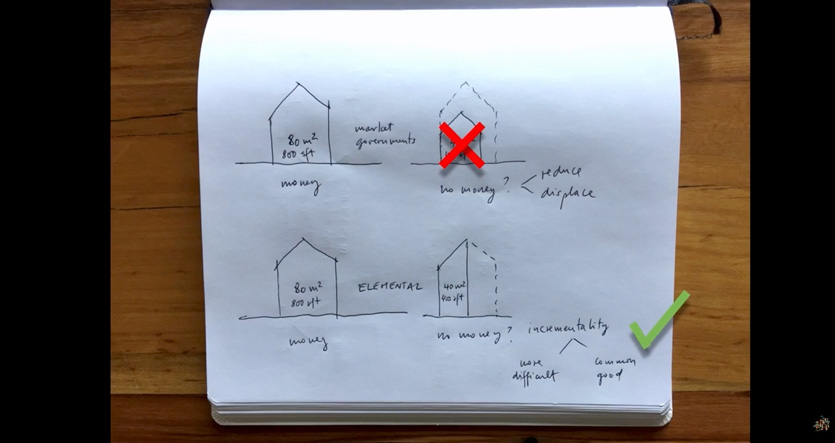
In 2001, Elemental was commissioned by the Chilean government to house 1,000 families on a 5,000-square-metre site. A study of the context revealed that residents tended to extend their 40-square-metre social housing units, often without permission, until they reached around 80 square metres. With this in mind, Aravena developed what he called an “incremental” approach to social housing.
Given the very limited public funding available to create neighbourhoods offering adequate living conditions, Elemental used government resources to build “half of a good house”, leaving enough space alongside each unit for families to extend their homes later as their means allowed. That is exactly what happened. The gradual expansion of the homes created a positive cycle, transforming social housing expenditure – normally seen by governments as a cost – into an investment with both economic and social value.
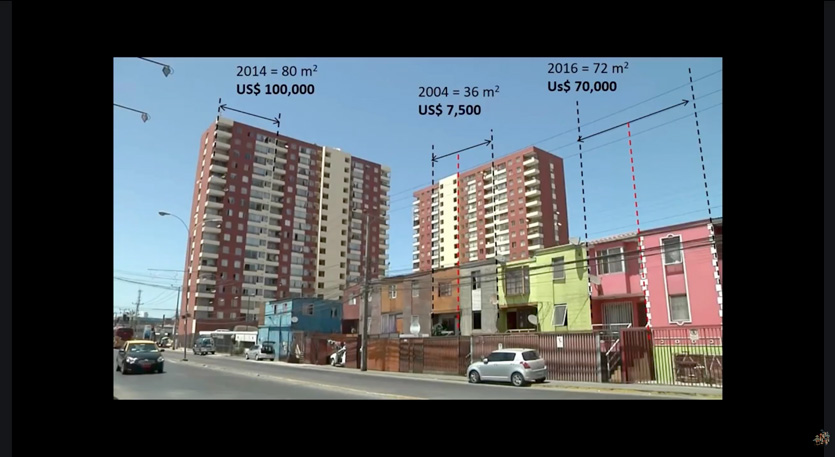
“For this to work, there has to be sufficient open public space, so the most important question in social housing is the location. If homes are built close to workplaces, for example, families spend less on transport and can eventually afford to extend their homes. If they are built in the suburbs and residents face a two-hour commute, families have less disposable income. Leaving room for extensions also results in property values increasing over time. Following Elemental’s intervention in Chile in 2001, house prices in the Quinta Monroy area increased tenfold.”
Reconstruction after natural disasters
Following the devastating fire in Viña del Mar, Chile, in 2024, speed became a critical factor in reconstruction. Drug trafficking groups were already attempting to gain a foothold in the reconstruction process, while many of those left homeless refused to move into temporary accommodation.
Elemental developed its proposal in consultation with the affected families. Prefabricated steel structures were then used to enable rapid construction. Permanent multi-storey housing was completed within a year, an eternity for the families waiting for a home but an exceptionally short time for permanent construction. The experience showed that it is possible to build both quickly and well. The fact that the process took a year was not down to technical constraints, as the loadbearing structure itself could have been erected in 24 hours. The delays were caused by other factors, above all bureaucracy.
Hospital de la Paz in Colombia
“We had never designed a hospital before,” Aravena said, “but we were asked to take on the project because of our participatory design approach.”
Aravena and his studio were working in a country still living with the consequences of a long and bloody internal armed conflict that ended with a peace agreement in 2016.
The brief was to create a facility capable of caring for the approximately 20,000 people who experience sexual violence in Colombia each year. Around 85% are women, but victims also include men, transgender people, gay people and other members of the LGBTQ+ community. The decision was taken to involve Dr Denis Mukwege from the outset. The 2018 Nobel Peace Prize laureate had founded a similar hospital in Congo, and his experience offered a model that could be adapted to the Colombian context. “We listened to some of the survivors, each one of whom had suffered violence,” Aravena said. “I don’t want to describe the horrific stories we heard – stories of such cruelty that they seem to strip away humanity itself. But then you sit around a table with people who have endured unimaginable experiences, yet who are determined to prevent the same thing from happening to others. This was the most emotionally challenging project we have ever undertaken. Together with the survivors, we met the investigating magistrates, the Minister of Health, psychiatrists, psychologists and Dr Mukwege. We visited the site where the hospital will be built and studied both the site and the design together with the survivors.”
Aravena went on to explain that the design was shaped by the survivors’ needs and requests, as well as by negotiations with the Ministry of Health.
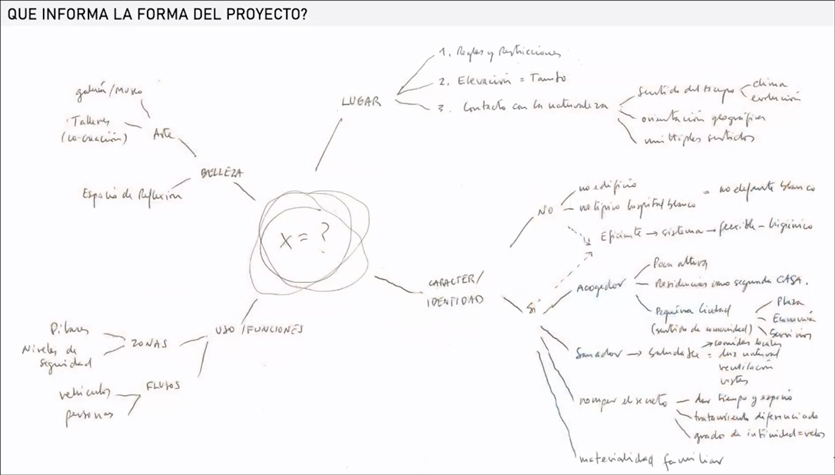
“The survivors were absolutely clear that, whatever form it took, the hospital must not feel like a hospital: no white surfaces, no tall buildings and nothing that immediately suggested a healthcare facility. The institutional coldness of a conventional hospital is simply not appropriate for people who have experienced this kind of trauma.”
Security is also a major consideration in Colombia, including inside the hospital itself. Some areas are therefore freely accessible while others are restricted, particularly because the hospital will serve the wider community as well as survivors of sexual violence. To avoid making survivors explain publicly to security staff why they are there at each checkpoint, the project includes a dedicated entrance and a separate route to the cafeteria, giving them time and privacy to overcome the initial difficulty of entering the hospital.
Beauty and art also play an important role, as explicitly requested by the survivors, so the hospital will include an art gallery for temporary exhibitions.
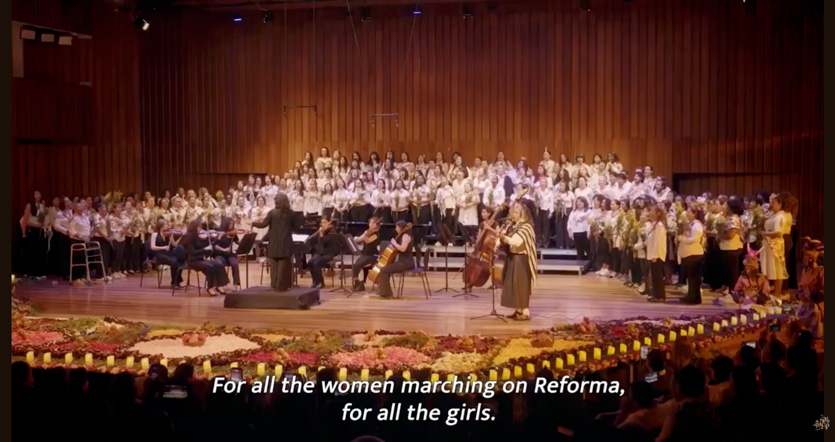
Aravena’s powerful Keynote Lecture, organised in collaboration with Interni magazine, concluded with the screening of a video showing the final project being presented to the survivors in a large theatre while some of them performed a poignant song written by singer-songwriter Vivir Quintana.
Watch Alejandro Aravena’s Keynote Lecture at Cersaie 2026.