











Interviews


Synergy and a systemic vision
(September 2025) | ATI Project is a young firm – the average age of its team members is just 34 – that offers a fresh and forward-looking approach to multidisciplinary design. Sustainability is both the inspiration and goal of its research and is central to its integrated processes, a key measure of feasibility for clients’ investments and increasingly a focus of public awareness.
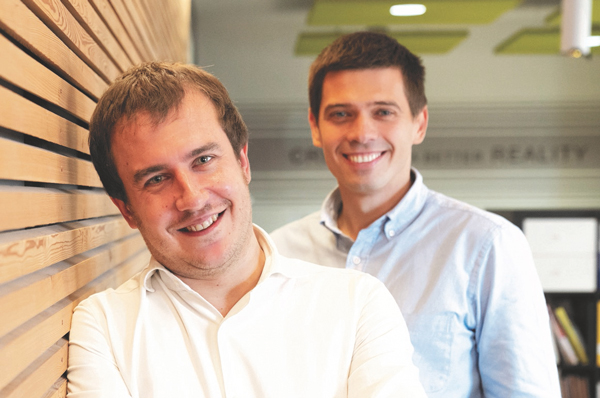
ATI Project was founded by Luca Serri and Branko Zrnic, who brought together their expertise in two key areas of low-energy construction: applied energy and bioclimatic architecture. Their aim was to bring every stage of design into a coordinated process managed by a single in-house team with multidisciplinary skills. With a team of over 350 professionals, ATI Project covers everything from architectural, structural and MEP design to site supervision and construction management and aims to deliver fully integrated BIM-based projects that prioritise resource efficiency and cost effectiveness. The firm specialises in public buildings and corporate headquarters and is continuing to grow both in Italy and internationally with a strong focus on innovation and sustainability.
Practical and informal in their approach, Serri and Zrnic are advocates of positive change, promoting the sharing of best practices. But, as they point out, “Imagination alone isn’t enough. We’re accustomed to building.”
How did ATI Project come into being, and why did you choose that name?
The idea behind ATI Project was to create a design model that would bring together architecture, engineering and sustainability in a truly integrated process, an approach that was still uncommon at the time. From the outset, we combined our complementary skills: Branko in architectural and structural design, Luca in MEP systems and energy. The idea came to us during a CasaClima course we were both attending in Bolzano, where we realised we shared the same vision of integrated sustainable design as a practical, everyday approach. The name “ATI Project”, an acronym for Architecture Technology Integrated Project, reflects this integrated approach between disciplines, informed use of technology and a commitment to responsible design.

North Tower, Pisa.
What is your design philosophy and business vision?
Three core principles guide all our work: sustainability, innovation and collaboration. Right from the start, we invested in multidisciplinarity with the aim of achieving real integration between architecture, engineering and technology. We founded the practice in 2011 and by 2012 had already adopted BIM as a daily working tool. This allowed us to develop a solid methodology that facilitates collaboration between teams with different skill sets right from the beginning of each project. We see integrated design not just as an operational technique but as a practical approach to projects based on a systemic vision, interdisciplinary synergy and constant attention to the quality of both the process and the results.
So you embrace integrated design, teamwork and a multidisciplinary approach. How do you work together in practice?
Teamwork is central to the way we operate. Teams are organised by skills, but there is always a strong emphasis on cross-disciplinary dialogue. Each project takes shape through open, continuous exchanges involving architects, engineers, sustainability specialists and other technical figures from the earliest stages. We use collaborative digital tools and clear workflows, but what really sets us apart is our culture of shared work and responsibility. We value autonomy, mutual trust and the unique contribution of each individual.

Pisa Training Centre, Pisa.
Sustainable, low-impact construction is another key focus of your work. Which projects have been particularly important milestones for you?
One of the major turning points in our growth was the project for the new Forti Holding Headquarters in Montacchiello, Pisa in 2012, which was the first time we had won a design competition. It was the first real test of our integrated approach and became the first office building in Tuscany to achieve LEED Gold certification. Another milestone was our CoHousing Zero project CH0, which was designed and built between 2014 and 2015 by a young team for a young team – namely ourselves. It was the first cohousing project with a timber structure built in Pisa and consisted of twelve apartments, eight of which became homes for our team members. In 2016, we won three design-and-build contracts for state schools: the Dino Compagni School in Florence and two schools in Milan (one in Via Strozzi and the other in Via Brocchi). These projects helped establish us in the educational building sector, which we see as critical in terms of its social impact and community value. Our next stop was Europe. With Nyt OUH – the new university hospital in Odense, Denmark – we took on one of the most complex challenges in our history. Developed for the Italian joint venture CMB-Itinera based on a concept by CF Møller, this was one of Europe’s largest hospital projects and helped us grow in terms of expertise, organisation and international vision. And finally, Pisa. Two projects testify to our strong ties to the city: the new Pisa Training Centre for Pisa Sporting Club, and Torre Nord, the city’s first business tower and part of a wider regeneration project in the Cisanello district, which is set to become a new professional and urban hub for the city.
Could you tell us about your new headquarters in Pisa?
Our new headquarters will be located inside Torre Nord, but for us it’s more than just a move, it marks our coming of age. After years of growth, we wanted a space that truly reflects who we are: a close-knit, dynamic team open to innovation and sharing of ideas. We will occupy half the tower, while the other half is already being filled by companies and professionals who share the same proactive, inquisitive and forward-thinking spirit. That’s the kind of environment we wanted: not an isolated office but part of a living, evolving ecosystem. We also chose to invest in Pisa, the city where we studied and founded ATI, because we believe in its value and potential. Torre Nord will be more than just a workplace, it will be part of the city’s network: a hub that creates connections, attracts talent and generates new synergies among professionals, businesses and the local community.

Nyt OUH University Hospital, Odense, Danmark.
ATI Project is a young firm of digital natives. Could you share some examples of how you’ve used BIM in innovative ways and others where you’ve adopted AI?
Our R&D team has been exploring the use of artificial intelligence in the AEC sector for years. It’s a constantly evolving technology that is already changing the way we operate in concrete ways. We use AI for data analysis, concept visualisation and optimising design feedback. We’re also integrating it into LCA and LCC analysis, using our internal database to carry out ever more detailed and efficient assessments. For us, AI doesn’t replace creativity, it enhances it. It speeds up exploration and makes evaluations more precise and comparisons more meaningful. In view of the rapid pace of its development, we’re continuing to invest time, energy and expertise in understanding and making the most of its potential.
Have you used ceramics in your projects? Do you think it has development potential in future design applications?
Absolutely. Ceramics is a material we use thoughtfully and in many different ways. This includes use on interior floors and walls, where it contributes to both the functionality and character of spaces, and in more technical applications such as ventilated façades, where it improves the energy efficiency of buildings and enhances their identity. It’s an ancient yet constantly evolving material that is well-suited to contemporary needs. Thanks to its adaptability and ability to interact with other materials and architectural languages, it plays a valuable role in our projects.
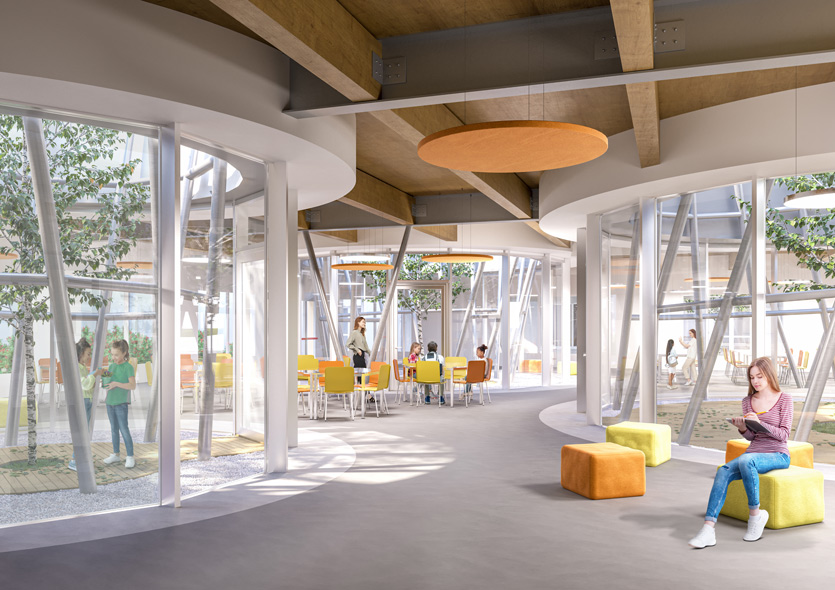
Primay School and Civic Center, Via Brocchi, Milan.
BIOGRAPHY
BIOGRAPHY
ATI Project is an international architecture and engineering firm specialising in integrated design, with a strong and ongoing commitment to sustainability and innovation. Founded in 2011, it has main offices in Pisa, Milan and Belgrade and employs more than 350 professionals.
The firm operates in fields with high social and technological impact, designing hospitals, university campuses, residential and office buildings, civic spaces and data centres.
Sustainability lies at the heart of ATI Project’s approach aimed at creating resilient, welcoming and future-ready spaces. At the same time, all processes are driven by research and innovation, with a focus on BIM, computational design, data analysis and artificial intelligence for more responsible and informed design.
