











Technical


BIM specifications for sanitaryware
(March 2026) – The adoption of BIM (Building Information Modeling) in Italy is no longer merely a forward-thinking choice; it is a necessity driven by regulatory and market evolution. With the new Public Procurement Code making BIM mandatory for works with a value exceeding €2 million starting in 2025, every building component must be transformed into an information-rich “digital twin”. In this context, sanitaryware occupies a unique position: a sanitary fixture is not just an architectural element, but the point of intersection between physical space and the building’s mechanical, electrical and plumbing (MEP) systems.
Since 2019, Confindustria Ceramica has been pursuing an ambitious project to develop specific “BIM specifications” for three macro-categories of products: ceramic tiles, heavy clay products and, as of 2024, sanitaryware.
In digital terms, these BIM specifications serve as the data template for specific product characteristics (properties grouped into “PropertySets”). This template guides manufacturers in compiling the data required to create their own digital BIM catalogues. It is not just a technical tool, but a fully-fledged cultural manifesto aimed at integrating the design, regulatory, environmental and digital requirements of today’s market with the ultimate goal of promoting high-quality Italian-made products.
The technical objective is to provide architects, engineers and public or private clients with a unique, reliable and compliant reference for integrating sanitaryware into Building Information Models (BIM) according to national and international standards.
The regulatory and legislative context in Italy and worldwide
The digitalisation of the construction industry is now a global reality driven by increasingly intense regulatory pressure. In Italy, the new Public Procurement Code (Legislative Decree 36/2023) makes digitalisation its main focus and dedicates Annex I.9 almost exclusively to BIM. This Legislative Decree has made the use of BIM mandatory for all public projects with a value exceeding €2 million, while allowing contracting authorities to implement BIM methodologies voluntarily should they wish to do so.
This is not just an Italian initiative but part of a global shift towards digitalisation of the construction sector that began with Directive 2014/24/EU on public procurement, which encourages the use of digital tools such as BIM to improve efficiency, transparency and sustainability. The EU’s drive towards digitalisation is spreading rapidly to all areas of the construction sector. Digital Product Passports, the new CPR (Construction Products Regulation), DoPCs and “Smart CE” markings are all moving toward a digital future using consistent, BIM-compatible data structures as a logical progression for the industry.
The development and adoption of international standards (ISO 19650 series) define clear guidelines for information management throughout the life cycle of built assets. Within this framework, the building products sector is required to provide structured, interoperable data that complies with the requirements of both clients and BIM platforms.
The BIM specifications for sanitaryware
The BIM sanitaryware specifications were drawn up through a collaborative and participatory approach by a multidisciplinary team consisting of member company representatives coordinated by Confindustria Ceramica.
The specifications have three objectives:
- To provide a “standard” data structure for the digital representation of ceramic sanitaryware, ensuring the consistency, quality and completeness of data.
- To facilitate the integration of digital products into BIM processes for design, quantity surveying, management and maintenance of buildings.
- To support sustainability through the digital traceability of materials, environmental performance and product life cycle.
The specifications cover the following categories of sanitaryware: washbasins, water closets (WCs), bidets, shower trays, baths and urinals (the most widely used fixtures in the residential market).
Following on from previous projects in the Tiles and Heavy Clay sectors, the BIM sanitaryware specifications serve as a technical data structure (data template) for product properties. Rather than imposing rigid obligations, they provide a guided framework and rules for correct BIM implementation during the creation of digital product catalogues. They become a kind of standardised digital identity card containing: geometric properties (dimensions, shapes, clearances); technical properties (materials, finishes, resistances, MEP compatibility); informational properties (codes and certifications); environmental properties (recycled content, LCA impact, durability).
The template is designed to be interoperable with leading BIM software (Revit, Archicad, ARCHline.XP, Allplan, etc.) and compliant with the IFC (Industry Foundation Classes) standard, thus ensuring widespread adoption. Without such guiding specifications, each manufacturer would provide data in different structures and formats, making it impossible for designers to manage the information correctly.
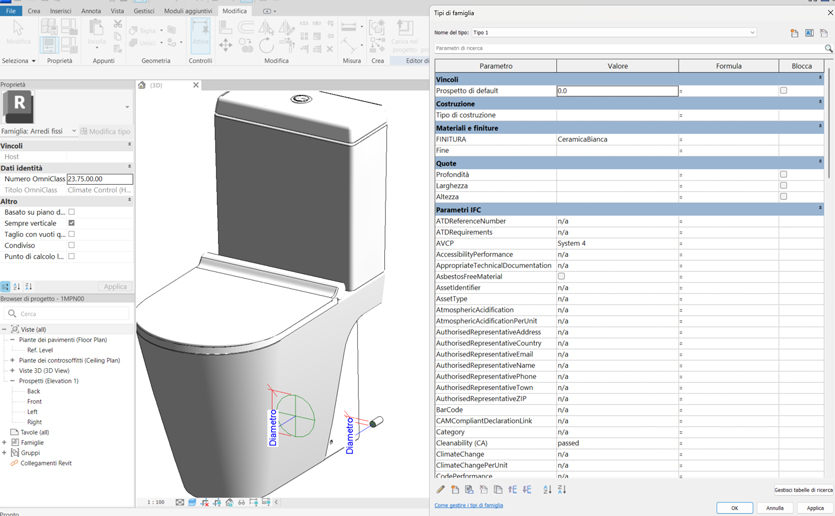
A twofold requirement: architectural and MEP engineering
The BIM object is designed to meet the requirements of designers, MEP engineers and facility managers, specifically addressing:
- Architectural and aesthetic requirements: the model must faithfully reflect the design and visual impact of the product.
- Functional and MEP (Mechanical, Electrical, Plumbing) requirements: designers must find the data they need in the data template to integrate the sanitary fixture into the building-MEP system without errors.
When these needs are met, the specifier becomes the primary driver of the supply chain, evolving from a simple user to a product “ambassador” for the end client.
For architects, a BIM object not only needs to look right within a rendering but must also support regulatory compliance, spatial coordination, classification and sustainability. For MEP engineers, the BIM object is a component of the plumbing system, complete with connectors and flow logic. The BIM MEP object defines the exact position, diameter and system type (e.g. domestic cold water, sanitary drainage) for every connector, all of which are essential for correct pipe sizing.
From supplier to strategic partner
Sanitaryware manufacturers who invest in BIM models take a strategic step up from mere suppliers to knowledge partners, offering compliant geometries, precise specifications and reliable data, thereby reducing costly on-site modifications and design errors. The BIM sanitaryware specifications connect the quality of Italian-made products with the “digital construction site”, enabling manufacturers to guarantee that their products are correctly specified and integrated into BIM processes. This reduces construction errors and improves sustainability over the building’s entire life cycle.
The BIM specifications stand as a virtuous example of how an industrial sector can use concrete tools to anticipate the challenges of digitalisation and sustainability. At a time when data, traceability and environmental responsibility are central to the construction supply chain, this initiative marks a milestone on the road to a more efficient and circular future.
