(October 2026) – European real estate investment continues to show resilience despite geopolitical uncertainty, with Southern Europe providing much of the momentum and logistics, housing and data centres driving growth.
According to the Investment Outlook published by Scenari Immobiliari and presented in September at the 34th Real Estate Forum in Rapallo, European investment volumes reached €103 billion in the first half of 2026, up 3% year on year. Second-quarter volumes alone totalled €53 billion, 6% higher than in the same period in 2025. “Investors are focusing on assets that offer secure income streams, transparent pricing and credible long-term demand,” the report states. Among the major markets, the UK recorded the largest fall in activity, with investment down 16% year on year to £21 billion (€24 billion) in the first half of 2026. Some smaller markets, including Belgium, the Czech Republic and Denmark, saw steeper percentage declines, but their impact on overall European investment was more limited. By contrast, several markets continued to perform strongly. Finland, Poland and Sweden recorded annual growth of 100%, 93% and 80% respectively. Spain remains one of Europe’s strongest-performing markets, with investment activity rising by 60% to €12.5 billion. Germany and France recorded more modest year-on-year growth of just 3%. Italy also performed strongly, setting a new record with more than €7 billion invested in the first half of the year, up more than 30% year on year.
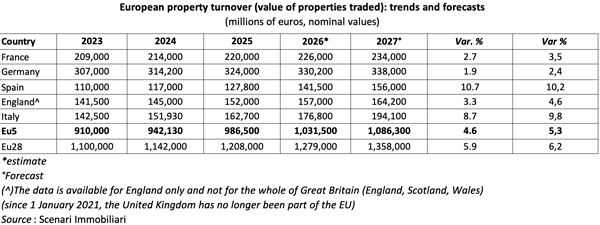
Across Europe’s five main property markets, real estate turnover reached almost €987 billion in 2025 and is forecast to exceed €1 trillion in 2026, an increase of 4.6%, before growing by a further 5.6% in 2027. Across Europe as a whole, the market is expected to reach €1.358 trillion by 2027. Germany remains the largest market by value, estimated at more than €330 billion in both 2026 and 2027, although annual growth is expected to remain below 3%. France also remains a major market, with volumes forecast to rise from €220 billion in 2025 to €234 billion in 2027. The strongest growth prospects, however, are in Spain and Italy, according to Mario Breglia, CEO and founder of Scenari Immobiliari. Spain, he notes, “is the fastest-growing market in the European sample, with growth of more than 10% projected for both 2026 and 2027. In absolute terms, real estate turnover is expected to rise from €127.8 billion in 2025 to €156 billion in 2027, driven by demographic growth and strong interest in the residential and tourism sectors.”
Italy closely follows Spain in growth terms. Scenari Immobiliari expects the Italian market to expand from €162.7 billion in 2025 to €194.1 billion in 2027, with growth of 8.7% in 2026 and 9.8% in 2027, driven by strong overseas interest and growing demand for property in major cities and leading tourist destinations. The UK, meanwhile, is expected to follow a steadier growth trajectory, with market turnover projected to reach €164.2 billion in 2027. Alternative assets remain particularly active, notably student housing, multifamily housing and data centres.
Logistics continues to be the most dynamic segment in almost every market, driven by e-commerce and growing demand for modern logistics infrastructure. Residential property values vary considerably from country to country. Spain again leads the market, with price index growth of more than 10% between 2025 and 2026 and a further 7% projected in 2027. Italy is also growing strongly, with increases of more than 4%, while France and Germany remain positive but trail the Southern European markets. The office sector remains relatively steady, with average European growth of between 2% and 3%, while retail is recovering and showing clear signs of consolidation.
The outlook for property sales is also encouraging, with transaction numbers expected to grow over 2026 and 2027, although recent increases in borrowing costs could still disrupt the market. Italy and Spain once again rank among the most dynamic markets. Italy is expected to record more transactions than Spain, with 800,000 sales forecast for 2026 and 840,000 for 2027, placing it behind only the UK and France. France experienced the steepest decline between 2022 and 2024, but the recovery that began in 2025 is expected to continue through 2026 and 2027. Similarly, Germany’s residential property market appears to be past the most difficult phase of the cycle. However, a persistent housing shortage and sharp contraction in construction activity continue to weigh on the market, driven by high building costs, difficulties in obtaining planning permission and higher interest rates.
Si informa che questo sito utilizza cookie, anche di terze parti, al fine di analizzare il traffico sul sito e personalizzare i contenuti e gli annunci più adatti a te.
Cookie Policy