Hotel De Len,
(June 2026) – Gris+Dainese Architetti grew out of two distinct professional journeys, between New York and Padua. The result was a creative partnership built on complementary strengths: Stefano Gris’s obsession with drawing and detail, and Silvia Dainese’s instinct for spatial narratives, light and emotional experience. Today, the studio is a compact multidisciplinary atelier where light is treated as a material in its own right, wood and ceramics enter into dialogue, and every project begins with a close reading of its context. From Cortina’s mountain huts to cable car stations, the aim is to give contemporary form to local building traditions: timber façades that filter views, mineral roofs that echo the surrounding Alpine crags and carefully considered energy solutions. In museums, narrative becomes space, with volumes and routes that anticipate the stories they contain.
How did your practice come into being?
The studio originated from the merger of two existing practices: mine, which had been working between New York and Padua since 1990, and Stefano’s, which was already well established. We knew each other well and often exchanged ideas and advice, but in a sense we were also competitors. We worked in the same areas – exhibition design, branding and installations for major groups – although with different clients.
From 2000 onwards, our relationship became closer, both personally and professionally, and was built on constant dialogue. The decision to join forces formally came after the Lehman Brothers collapse, partly as a way of pooling our strengths and partly to relaunch the business at a particularly delicate economic moment.
From then on, our shared history was built on a very strong complementarity. Stefano had an almost obsessive approach to design: he could hold the overall vision of a project together while also controlling the smallest details, as though he were constantly zooming in and out, from the large scale to the tiniest element. Drawing was his natural territory. White and yellow tracing paper would fly around the studio as he redistributed tasks and refined the project.
My approach was more that of a film director. I built the narrative of the project, imagining the lighting, transitions and proportions, and focused closely on what people would experience within a space: how they would perceive it, how they would feel and whether it would make them happy.
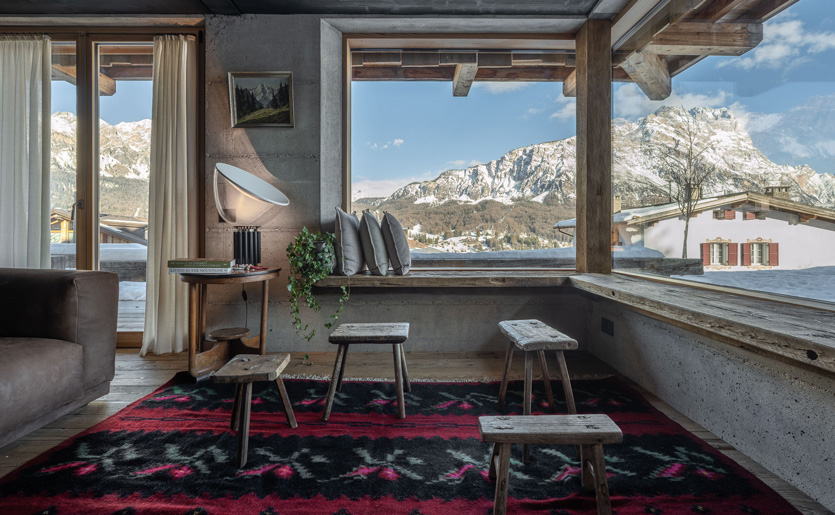
When we moved, almost by chance, from exhibition design into hospitality and interiors, we realised how deeply our experience in museums and galleries had shaped our understanding of light. For us, light has always been a design material in its own right, alongside resins, concrete, steel and timber – from spruce and larch to Swiss stone pine.
Stefano’s contribution continues to shape the practice today. What is his intellectual and professional legacy and how are you continuing to develop the original ideas on which the studio was founded?
Stefano’s legacy is still very present, not only in me but also in all the people who have worked with us over the years. During project meetings, I often recognise his way of thinking in the words of our collaborators.
His legacy is one of rigour and a form of creative obsession. He knew how to keep the finished project under control while at the same time concentrating on the smallest details. We developed an approach in which light, materials, landscape and sound are always considered together. That way of working continues to shape the studio today and is constantly reinterpreted through the vision and contribution of our younger architects.
When you talk about “methodological consistency as the compass of the design process”, are you also referring to this multidisciplinary way of working and to your relationship with local craftspeople and external specialists? Does that begin from the earliest stages?
Absolutely. For us, methodological consistency begins in the very first stages of a project and continues all the way through to the construction site.
We always aim to create architecture that appears simple but is rooted in a complex understanding of materials and local craftsmanship. The sense of place plays a central role in every project. Designing in Sicily is worlds apart from designing in Cortina, because the building traditions, climate, materials and landscape are completely different.
We like to think of our work as being in harmony with the landscape. Our greatest satisfaction comes when someone says: “This building looks as though it has always been here.”
Looking at your projects in Cortina – both completed and ongoing – one senses a deep engagement with local building types, somewhat reminiscent of Franco Albini and Edoardo Gellner in their reinterpretations. It seems to me that this goes beyond mere “mimicry” and becomes a more complex operation involving traces and memory.
As you rightly say, it is not about superficial mimicry. It is a more complex exploration of building types, local memory and the character of a place, which we try to understand, reinterpret and bring into a contemporary dimension.
The reference to Albini and Gellner is very apt, because both worked with great sensitivity towards tradition. Our work on mountain architecture begins above all with the study of building types, which change according to altitude and function.
At around 1,200 metres, for example, masonry structures incorporating timber elements, each with a precise function, are more common. Higher up, you find mountain huts, barns and lighter structures, where timber acts both as façade material and as a filter.
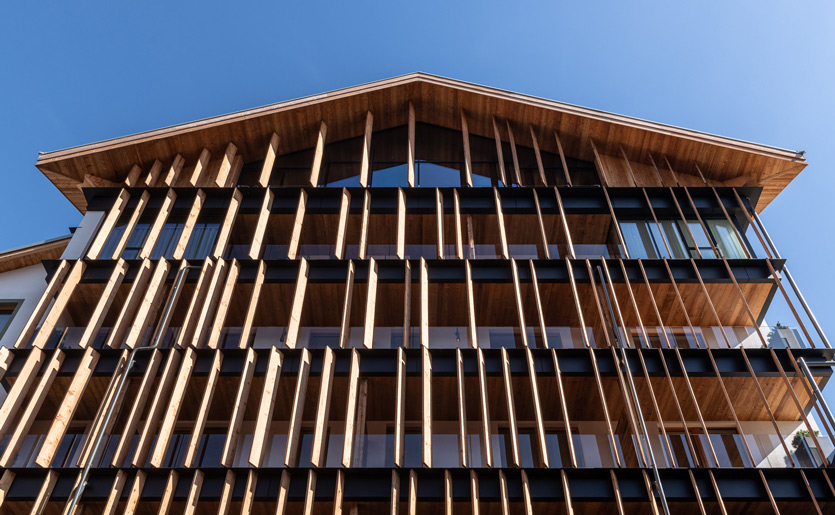
From these building types came the idea of timber façades that act almost like a screen in front of contemporary glazing, softening and filtering it without trying to hide it completely. We transformed the timber boards traditionally used in barns into brise-soleil elements, giving them a new role: no longer allowing air to circulate around stored hay, but filtering daylight in a harmonious way.
Some projects adapt to the landscape and change with altitude, with architectural expression and materials evolving as the elevation increases. At intermediate levels, timber becomes more prominent, whereas at 2,500-2,700 metres the roofscape becomes sharper and more mineral in character, echoing the surrounding rock formations. In some cases, service structures are partly underground and almost invisible, further reducing their visual impact.
At the same time, we have set ourselves highly ambitious energy targets: Class A buildings designed to minimise energy consumption, retain heat during winter and provide protection from the sun in the summer. In this sense, research into typologies is closely intertwined with research into technologies and performance, maintaining a constant balance between past and present.
Could you tell us about your latest projects in Cortina: the cable car stations and the Faloria mountain refuge?
For the cable car stations, the client approached us during the transition from chairlifts to cable cars, asking us to consider not just the technical infrastructure but the architecture as a whole.
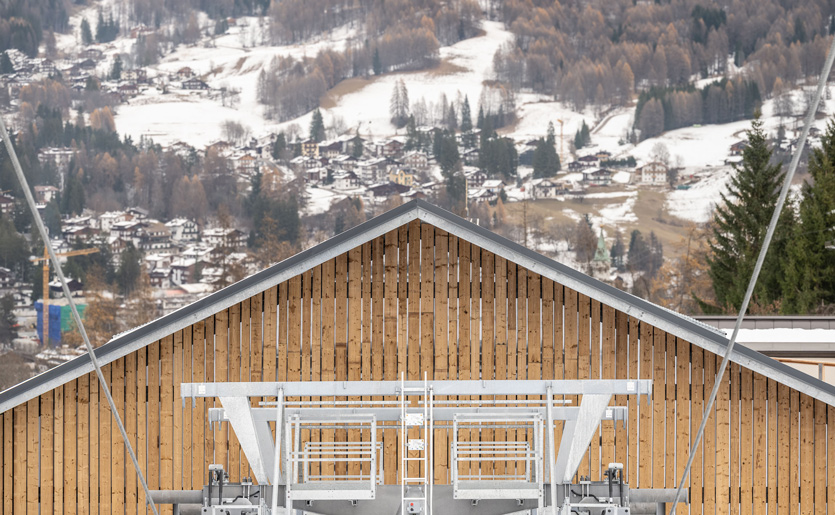
Our response was to draw inspiration from Alpine mountain huts. Rather than using standard metal cladding, we chose thermally treated timber to enclose the technological structure and soften its impact on the landscape.
The Faloria Refuge, by contrast, grew out of a study of the original building commissioned by Baron Franchetti and the various additions made over the years. The company managing the lift system was considering whether to turn it into a small high-altitude hotel or keep it as a mountain refuge and restaurant.
The current proposal retains the ground floor for mountaineers, ski schools and skiers, while reorganising the upper levels within the permitted extensions. Here too, the relationship between masonry and timber is central. Timber envelops the building, protects the glazing from intense sunlight and softens the building’s visual impact on the mountain landscape.
Among the materials you use, what role does ceramic play in mountain architecture? Is it suitable or do you see it as alien to the Alpine context?
We use ceramic materials, particularly porcelain stoneware, selectively. We prefer full-body porcelain surfaces in dark, matt and sometimes textured finishes, because these work best alongside timber without competing visually.
We employ them in areas subject to heavy wear, where long-term durability is essential. Our view is that all the materials in a project should offer a comparable lifespan. If timber and concrete are intended to last for decades, ceramics should offer the same durability without requiring disproportionate levels of maintenance.
Si informa che questo sito utilizza cookie, anche di terze parti, al fine di analizzare il traffico sul sito e personalizzare i contenuti e gli annunci più adatti a te.
Cookie Policy